
What Is the Right Age to Start Violin Lessons?
It is one of the first questions parents ask when they start thinking about music lessons: what is the right age to start violin lessons? The honest answer is that there is no single magic number. The right age has far more to do with a child's readiness than with a birthday, and the violin is unusually accommodating here, because fractional sizes let children begin remarkably young.
This guide walks through what starting looks like at each stage, from preschoolers to adults, and how to tell when your own child is ready. By the end you should have a clear sense of the path that fits your family.
Is There a Right Age to Start Violin Lessons?
There is no universal right age to start violin lessons, only the right moment for a particular child. Some children flourish beginning at three or four. Others do better waiting until they are six or seven, and plenty of people pick up the instrument for the first time as teenagers or adults and do beautifully.
What makes the violin different from many instruments is sizing. Violins come in fractional sizes, from a tiny 1/16 all the way up to a full 4/4, which means the instrument can be matched to a very small child rather than the child waiting to grow into it. That removes the physical barrier that holds back early starts on larger instruments, and it is why the readiness questions below matter more than the calendar.
Signs Your Child Is Ready to Start Violin
Readiness shows up in behavior long before it shows up as an age. A child who is ready to begin can usually focus on a single activity for ten to fifteen minutes, follow simple two-step directions, and sit or stand still for short stretches. Just as important, they show genuine interest, asking about the instrument, responding to music, or wanting to imitate what they see. None of these require a specific age. A focused, curious four-year-old may be more ready than a distracted seven-year-old. If you are seeing these signs, your child is likely ready to start, whatever the number on their last birthday cake.
Starting Violin in Early Childhood (Ages 3 to 5)
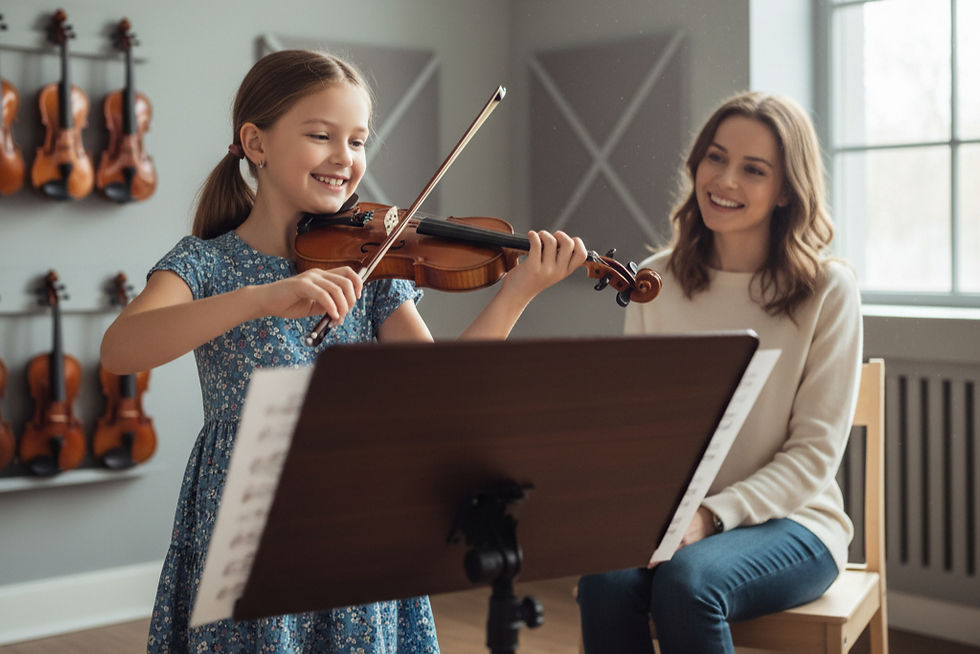
Early lessons look nothing like a teenager's practice session, and they are not meant to. For a preschooler, lessons are short, playful, and built around listening, imitation, and games rather than reading music. The goal at this stage is a good ear, comfortable posture, and a love of the instrument, not technical polish.
Two things make early starts succeed. The first is a properly sized fractional violin, so the instrument fits small hands and arms. The second is parental involvement. Very young children practice best with a parent gently guiding a few minutes each day, so this path works well when a parent can be present and patient.
Starting Violin in the School-Age Years (Ages 6 to 10)
For many families this window is the sweet spot. By six or seven, most children can focus longer, follow more detailed instruction, and begin reading music, while still being young enough to absorb technique quickly and build habits that last. Fine motor coordination has usually developed enough to make bow control and finger placement less frustrating than it can be for the very young. Children who start in these years often move at a satisfying pace, which keeps motivation high. It is a stage where real progress and genuine enjoyment tend to arrive together.
Starting Violin as a Tween or Teen
Parents sometimes worry that starting in the tween or teen years means missing the boat. It does not. Older beginners bring advantages a five-year-old cannot: longer attention spans, the ability to understand musical concepts quickly, and, often, their own motivation to play. A teenager who wants to learn can progress remarkably fast.
Later starts are also well suited to concrete goals, whether that is joining a school orchestra, playing in a worship setting, or simply learning a favorite piece. The later start is rarely the obstacle. Interest and consistent practice matter far more.
Adult Beginners Are Always Welcome
There is genuinely no upper age limit on learning the violin. Adults learn differently than children, drawing on patience, discipline, and clear personal goals, and many of our adult students find lessons to be a rewarding creative outlet in an otherwise busy life. Whether you played long ago and want to return, or you are picking up the violin for the very first time, it is never too late to begin.
Why the Right Teacher Matters More Than the Right Age
If there is one thing that matters more than age, it is fit. A teacher who knows how to work with a wiggly preschooler is doing a very different job than one preparing a teenager for an audition, and the right match makes all the difference in whether a student thrives. The best teachers adjust their pace, repertoire, and style to the age and temperament of the student in front of them.
This is also where teaching approach comes in. Some of our instructors draw on the Suzuki method, which is especially well suited to young beginners, while others lean more traditional for older students. Matching the approach to the child is the whole point.
Start Violin Lessons at Preston Harmony
Whatever your child's age, the best way to know if they are ready is to see them with a teacher. Schedule a free trial lesson at our Preston Hollow studio and we will help you find the right fit and the right starting point. We teach violin to children and adults of all levels, serving families across North Dallas, Highland Park, University Park, and Addison.
You can learn more about Violin Lessons and schedule a Free Trial Lesson today and let us help your young musician begin.
Warmly,
♫ The team at Preston Harmony School of Music
Frequently Asked Questions
What Is the Best Age to Start Violin Lessons?
There is no single best age. Many children begin between the ages of five and seven, which balances focus, coordination, and reading readiness, but younger children can start with a Suzuki-inspired approach and older beginners often progress very quickly. Readiness matters more than a specific age.
Can a 3- or 4-Year-Old Really Learn the Violin?
Yes. Because violins come in very small fractional sizes, even preschoolers can hold and play a properly fitted instrument. Lessons at this age are short and playful and rely heavily on listening and imitation, and they work best when a parent can help guide a few minutes of practice each day.
Is My Child Too Old to Start the Violin?
Almost certainly not. Tweens and teens learn quickly because they can grasp concepts and practice with purpose, and adults of any age can begin from scratch. A later start is rarely a barrier when interest and consistency are there.
Should My Child Start on Piano Before Violin?
There is no requirement to. Some families like starting on piano because notes are laid out visually, which can make early music reading simpler, but many children begin directly on the violin and do wonderfully. If your child is drawn to the violin, that interest is the best reason to start there. We teach both, so we are glad to help you decide.

