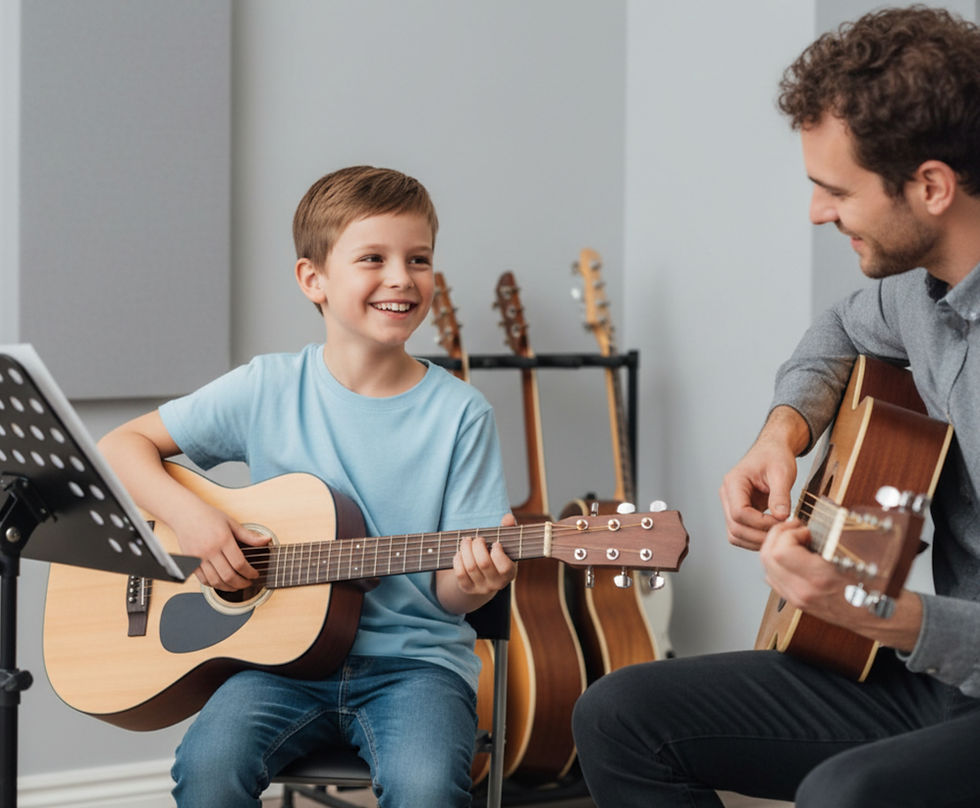
What Is the Right Age to Start Guitar Lessons?


One of the most common questions we hear from parents is what the right age to start guitar lessons really is. It is a fair question, and the honest answer is that readiness matters far more than a birthday. Some children are ready at six, while others do better waiting a year or beginning on a smaller instrument first.
This guide walks through what to look for at each age, and what to do if your child is eager but not quite ready for a full-size guitar yet.
What Is the Right Age to Start Guitar Lessons?
For most children, formal guitar lessons work well starting around ages 6 to 7. By that point, most kids have hands large enough to press the strings comfortably, the attention span to stay focused through a lesson, and the ability to follow simple instructions from a teacher. That said, the exact age is less important than the individual child, and a motivated five-year-old can sometimes thrive while a distracted eight-year-old may need to wait.
Signs Your Child Is Ready for Guitar
Rather than watching the calendar, watch for a handful of readiness signals. Look for hands and fingers strong enough to press a string down to the fret, an attention span that can handle a focused twenty to thirty minute lesson, the ability to follow simple directions, and, most importantly, genuine interest. Of all of these, interest is the strongest predictor of whether a child will stick with the instrument. A child who wants to play will practice, and practice is what turns early lessons into real progress.
Too Young for Guitar? Start With Ukulele
If your child is roughly 4 to 6 and eager to play but a full-size guitar feels like too much, the ukulele is often the perfect place to begin. Its smaller neck suits little hands, it has four strings instead of six, and its soft nylon strings are far gentler on young fingertips than steel guitar strings. Just as importantly, the ukulele teaches the same core foundations of rhythm, chord shapes, and listening that guitar depends on.
That makes it a real starting point rather than a consolation prize. You can learn more about beginning here on our Ukulele Lessons page.
Ages 6 to 9: A Natural Starting Point
This range is where many young guitarists begin, and for good reason. Lessons at this stage focus on comfortable posture and hand position, clean fretting, first chords and simple melodies, and the beginnings of reading music, all introduced at a pace that keeps a child encouraged. Progress tends to be steady rather than sudden, and small, consistent wins build the confidence that keeps kids coming back. A child who started on ukulele usually arrives with a real head start, since so much of what they learned transfers directly to the guitar.
Ages 10 and Up, Including Teens
Parents of older children sometimes worry they have missed a window, but the opposite is often true. Older beginners and teenagers frequently progress quickly, thanks to longer attention spans, stronger motivation, and the ability to practice more independently. Teens in particular tend to stay engaged when lessons are built around the music they already love, whether that is rock, pop, blues, or fingerstyle. Starting later is not a disadvantage, it is simply a different and often faster path.
Is It Ever Too Late? Guitar and Ukulele for Adults
It is never too late to start. Adults come to lessons for all kinds of reasons, from picking up an instrument for the first time to returning to one they set down years ago. For adults who want an approachable, low-pressure way in, the ukulele is a popular first step here too, and many students enjoy moving between both instruments. If you are considering lessons for yourself, our Music Lessons for Adults page explains how we tailor instruction to your goals and schedule.
How We Help Each Student Start at the Right Time
Because readiness looks different for every child, we start by matching each student with the teacher and pace that fit them best. Our free trial lesson is a low-pressure way to see how your child responds before committing to anything, and it often answers the readiness question better than any age guideline can. We use no long-term contracts, and we enroll year-round, so your family can begin the moment the timing feels right rather than waiting for a semester to start.
If you are ready to find out where your child fits, schedule a Free Trial Lesson and we will help you take the first step.
Warmly,
♫ The team at Preston Harmony School of Music
Frequently Asked Questions
What Is the Youngest Age a Child Can Start Guitar Lessons?
Most children are ready for guitar around ages 6 to 7, but eager younger children are not out of options. Children as young as 4 or 5 often begin on the ukulele, which is gentler on small hands, and then move to guitar later with a strong head start.
Do Children Need Their Own Guitar to Start Lessons?
We have demo instruments for the trial lesson. For weekly lessons, yes, guitar students bring their own instruments to each lessons and they need a guitar to practice on at home. It does not need to be expensive, and we are glad to help you choose an appropriately sized, beginner-friendly instrument before your child begins.
What Size Guitar Does a Young Child Need?
Guitars come in fractional sizes, and the right fit depends on your child's age and height rather than a single rule. Younger and smaller children are usually most comfortable on a 1/2 or 3/4 size, while older children and teens can often handle a full-size instrument. We are happy to point you to the right size at your trial lesson.
How Long Should a Young Child Practice Each Day?
For young beginners, short and consistent beats long and occasional. Ten to fifteen minutes most days is a realistic and effective goal at the start, and that amount grows naturally as a child's focus and interest develop.
Is It Better to Start on Guitar or Ukulele?
For most children who are ready by age 6 or 7, guitar is a fine place to begin. For younger children, or anyone who wants a gentler introduction, the ukulele is often the better first step, since it is smaller and easier to play and the skills transfer directly to guitar later.