
Acoustic Piano vs. Keyboard: What to Practice On at Home
One of the first practical questions parents face when signing up for piano lessons is what their child should practice on at home. Should you invest in an acoustic piano, or will a keyboard do? The acoustic piano vs. keyboard question is one we hear often, and the good news is that there is no single right answer, only the right choice for your family, your space, and your budget. This guide walks through what a beginner truly needs, the differences between your options, and how to choose without overspending or under-buying.
Do You Need a Piano at Home to Start Lessons?
The short answer is yes. While lessons are where your child learns new skills, practice between lessons is where those skills take root. A child who cannot practice at home will progress slowly and often grows frustrated, no matter how good the lessons are. So having an instrument at home is not optional, but the kind of instrument you choose has a great deal of flexibility. You do not need to spend a fortune, and you certainly do not need a grand piano in your living room. You simply need something that lets your child practice properly between lessons. That is where the real question begins: acoustic, digital, or keyboard?
Acoustic Piano vs. Keyboard: What Is the Difference?
Part of what makes this decision confusing is that families are usually choosing among three different things, not two, and the words are often used loosely. It helps to define them clearly.
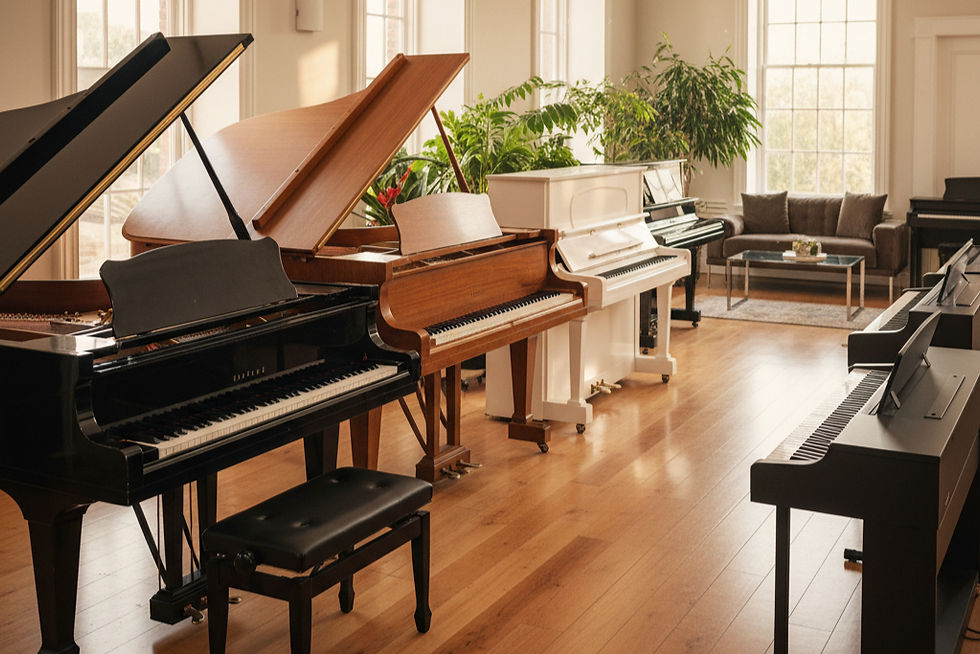
An acoustic piano is a traditional instrument, either an upright or a grand, that produces sound through hammers striking strings. A digital piano is an electronic instrument designed to look and feel like an acoustic, with a full set of weighted keys that mimic the resistance of the real thing. A basic keyboard is the lightest and least expensive option, usually with fewer keys and soft, unweighted keys that press down easily. These three are not interchangeable, and the differences between them matter a great deal for a young pianist, as the next sections explain.
What Matters Most for a Beginner
Whatever type you choose, a few features matter far more than the label on the instrument. If you keep these in mind, you will avoid the most common and most costly beginner mistakes.
Look first for 88 full-size, weighted keys. Weighted keys are the single most important feature, because they build the finger strength and control your child will rely on for years, and they let a student move to any real piano without relearning their touch. A full set of 88 keys ensures your child never runs out of range as they progress. Beyond the keys, a sustain pedal is important for developing proper technique, and a sturdy stand and an adjustable bench allow your child to sit with correct posture. An instrument that has these essentials will serve a beginner well, whether it is acoustic or digital.
The Case for an Acoustic Piano
An acoustic piano is the gold standard for good reason. Its tone is rich and full, and its keys respond to the smallest changes in touch, which allows a student to develop real expression and nuance. Playing on an acoustic instrument teaches a level of control that is difficult to replicate, and for a committed student, nothing quite compares.
There are trade-offs to weigh honestly. Acoustic pianos are the most expensive option, they take up considerable space, and they require regular tuning to stay in good playing condition. For families with the room, the budget, and a serious commitment, an acoustic piano is a wonderful investment. For many beginners, though, it is more than is needed to start.
The Case for a Digital Piano or Keyboard
For most families beginning lessons, a quality digital piano is an excellent and practical choice. A good digital piano offers weighted keys that feel close to an acoustic, along with real advantages: it is far more affordable, it takes up little space, it never needs tuning, and it allows quiet practice through headphones, which any parent of a beginner will appreciate.
There is one important caution. Not every electronic instrument is suitable. A basic keyboard with light, unweighted keys and fewer than 88 keys may seem like a budget-friendly way to start, but it can actually hold a student back, since it does not build proper technique and quickly becomes limiting. The line to draw is not acoustic versus electronic. It is a proper weighted instrument versus a toy, and a well-chosen digital piano belongs firmly in the first category.
Our Recommendation for Families Starting Out
If you are just beginning and unsure how far your child will take the piano, a good weighted digital piano is a smart, worry-free place to start. It gives your child everything they need to practice well without the cost or commitment of an acoustic, and you can always upgrade later if their passion grows.
It is also worth remembering where the most important playing happens. At Preston Harmony, every lesson takes place on a Steinway or Boston grand, so your child develops proper tone and technique on a world-class instrument each week. We have written more about why we teach only on grand pianos in a separate post. The home instrument does not need to match that. It simply needs to support daily practice with weighted keys and a full keyboard, so the skills built in the lesson can be reinforced at home. Start with an instrument that meets the essentials, and your child will be well equipped to grow.
We Are Happy to Help You Choose
Choosing a first instrument can feel like a big decision, and you do not have to make it alone. Before you buy anything, we are always glad to help. At Preston Harmony School of Music in Preston Hollow, we guide families across North Dallas, Highland Park, University Park, and Addison toward the right instrument for their space, budget, and child's level, whether that is a digital piano to start or an acoustic for a dedicated student. If you would like advice, or you are ready to begin, reach out to us and schedule a complimentary trial lesson. We will help you set your child up for success from the very first note.
Warmly,
♫ The team at Preston Harmony School of Music
